

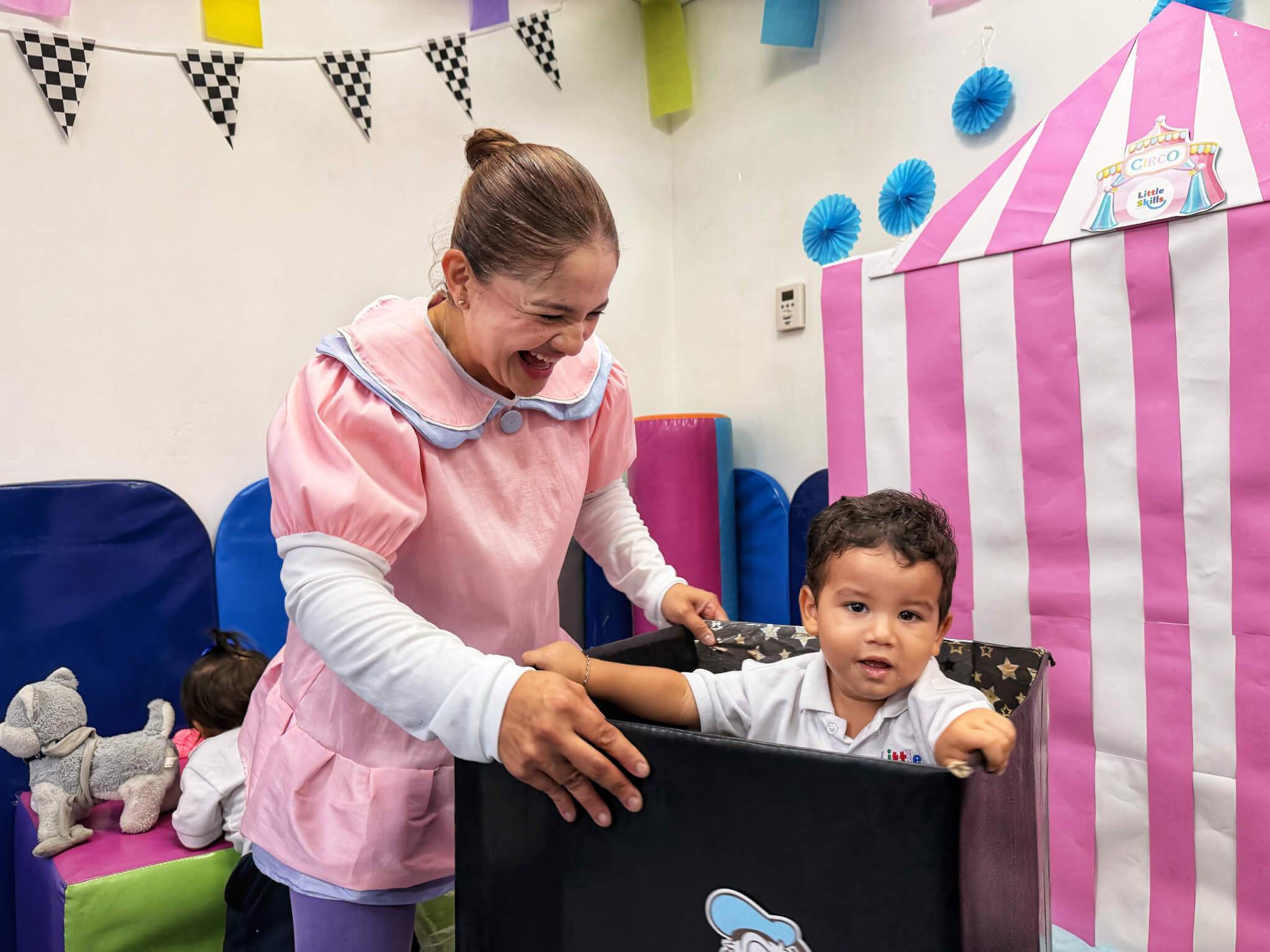
The early years of life are full of discoveries. Reaching for a toy, exploring a texture, recognizing a sound, or trying to move toward an object are experiences that, although they may seem small, represent important milestones in a child’s development. Through their senses and movement, children begin to get to know their bodies, understand their surroundings, and discover the ways in which they can interact with the world.
Translated with DeepL.com (free version)
For many families, supporting these learning experiences also means finding a balance between helping their children and allowing them to discover things on their own. When should they step in? How much time should they give their children to try something? How can they tell if an experience is contributing to their child’s development? These questions help us understand that fostering children’s autonomy does not mean demanding independence before they’re ready, but rather providing opportunities for them to explore, experiment, and learn in a safe environment with guidance.
At Little Skills, the neurosensory development program at the British School of Cartagena (CBC), we recognize the importance of the early years as a critical stage of growth. Understanding how children learn through their senses, movement, and interaction with their environment allows us to identify the experiences that contribute to the development of their skills and the gradual building of their independence.
Why is neurosensory development important for children's independence?
Children’s autonomy is a skill that develops gradually as they discover what they can do, engage with their environment, and acquire new skills. During early childhood, this process begins long before they are able to perform everyday activities without assistance. A baby who tries to reach for an object, changes position to explore, or responds to a sensory stimulus is already actively engaged in learning.
Neurosensory development is related to the way the nervous system receives, processes, and integrates information received through the senses and movement. These experiences allow children to learn about the characteristics of objects, recognize their own bodies in space, and develop increasingly coordinated responses to what is happening around them. Thus, sensory and motor experiences form part of the foundation upon which various skills related to independence are built.
For example, when a baby tries to pick up an object, he or she needs to coordinate what he or she sees with the movements of his or her hands. When exploring different surfaces, the baby receives information about their textures and characteristics. And when the baby begins to move around, he or she discovers new ways to interact with the space. These experiences involve sensory, motor, and cognitive processes that develop progressively through exploration and practice.
However, fostering autonomy does not mean expecting all children to achieve the same milestones at the same time. Each child has unique characteristics, interests, abilities, and needs that influence how they explore. Some need more time to observe before participating, while others show greater initiative when faced with new experiences. Respecting these individual paces is essential for development to occur in an environment of safety and trust, rather than under pressure to achieve specific outcomes.
Autonomy also has an emotional dimension. When a child explores a safe environment with an adult present who responds to his or her needs, the child can begin to tackle small challenges, express preferences, and discover new abilities. These experiences gradually build the child’s confidence and allow him or her to participate more and more actively in the world around him or her.
How do sensory experiences and movement contribute to the development of independence?
During early childhood, the brain learns from the experiences a child has while interacting with their environment. Movement, exploring objects, sounds, textures, and visual experiences provide information that contributes to the development of various skills. Therefore, a meaningful neurosensory experience does not depend on the quantity of stimuli, but rather on whether those stimuli are appropriate for each child’s needs and stage of development.
When a baby explores objects of different sizes, for example, they may be strengthening the coordination between their eyes and hands, practicing reaching movements, and discovering characteristics such as shape and texture. Similarly, experiences involving balance, movement, and changes in position allow babies to gradually become more familiar with their bodies and develop motor skills that promote more independent participation in daily activities.
These experiences can also involve different areas of development at the same time. An exploratory activity can engage cognitive, visual, auditory, tactile, and vestibular skills, as well as gross and fine motor skills and communication-related processes. The important thing is to understand that each experience should serve a purpose related to child development and not be limited to simply providing eye-catching materials or activities to keep the child occupied.
In this process, it is essential to recognize that more stimulation does not necessarily mean better development. An environment with too many sounds, lights, materials, or simultaneous activities can be overwhelming for some children. Therefore, it is important to observe their responses, recognize signs of fatigue or overstimulation, and provide experiences that respect their sensory needs and their own pace of participation.
Another essential aspect is allowing the child to take the lead in their own discoveries. Objects, materials, and spaces are tools that encourage exploration, but they should not become the focus of the experience. When an adult constantly directs every movement or immediately resolves a difficulty, it can limit the child’s opportunities to experiment, try things out, and find their own answers.
Respectful support involves observing, waiting, providing a sense of security, and facilitating the experience when necessary. Sometimes, it will be enough to simply give the child time to explore; at other times, it will be important to adjust a material, modify the environment, or intervene to ensure the child’s well-being. Autonomy begins to strengthen when the child has opportunities to discover what they can do on their own, with support appropriate for their stage of development.
How does Little Skills support children's neurosensory development and independence?
The early years of life are a stage in which sensory, motor, and interactive experiences play an important role in child development. Neurosensory development programs aim to provide opportunities for exploration and learning that take these dimensions into account, recognizing that each child perceives, experiences, and responds to their environment in a unique way.
At Little Skills, the neurosensory development program at the British School of Cartagena, we believe it is important to support children’s early discoveries from a holistic perspective. This means understanding that, while a child is exploring an object, they may also be practicing movements, using their senses, communicating their interests, and gradually strengthening their relationship with their environment.
For these experiences to be meaningful, it is important to consider each child’s individual characteristics. Their age, stage of development, interests, level of participation, and sensory needs are factors that guide how we support them. The goal is not for everyone to do the same activities or achieve identical results, but rather to recognize their potential and offer opportunities for exploration that are appropriate for their development.
Physical and sensory safety are also part of this support. The size and cleanliness of materials, the stability of surfaces, lighting, sounds, and the number of stimuli present in the environment are all factors that must be considered when designing experiences for young children. A safe environment allows children to explore with greater peace of mind, while adults observe and respond to their needs.
In addition, supporting a child’s development requires paying attention to what happens during each experience. Did the child show interest? Did the child explore freely? Did the child try a new movement? How did the child respond to stimuli? Did the child need help, or was the child able to figure something out on their own? These observations allow us to recognize progress and understand which experiences may be meaningful for continuing to support the child’s growth.
For families, this perspective offers a different way to recognize their children’s achievements. Autonomy is not measured solely by major milestones, such as learning to walk or performing an activity without help. It is also evident when a child expresses a preference, tries to reach for something that interests them, voluntarily participates in an experience, or discovers a new way of interacting with their environment.
At Little Skills by CBC, we aim to ensure that these small discoveries are valued as part of a holistic development process, in which neurosensory experiences and respectful guidance help build skills for the next stages of growth.
Because fostering independence from an early age does not mean rushing childhood, but rather providing each child with the time, security, and opportunities needed to gradually discover everything they are capable of doing.