
Disagreements are a part of everyday life. They can arise when two children want to use the same material, when a student feels that their opinion wasn’t heard, or when a group has trouble reaching an agreement. Although these situations often cause discomfort, they also present opportunities to develop skills that will be important throughout life.
For many families, it’s natural to wonder how to teach their children to resolve conflicts without resorting to arguments, impulsive responses, or behaviors that harm their relationships. However, learning to resolve conflicts doesn’t mean avoiding difficult emotions, but rather understanding them and developing tools to respond more mindfully.
At the British School of Cartagena (CBC), we recognize the importance of emotional education as part of a well-rounded education. Through RULER, an approach developed by the Yale Center for Emotional Intelligence, we can help students develop skills that enable them to recognize their own feelings, understand the emotions of others, and find constructive ways to resolve disagreements.
Why is it important for children to learn how to resolve conflicts from an early age?
Learning to resolve conflicts is a skill that is developed gradually through everyday relationships and experiences. From an early age, children begin to encounter situations in which their desires, needs, or opinions differ from those of others. These moments allow them to discover that not everyone thinks the same way and that living together also means learning to listen, express disagreements, and seek solutions.
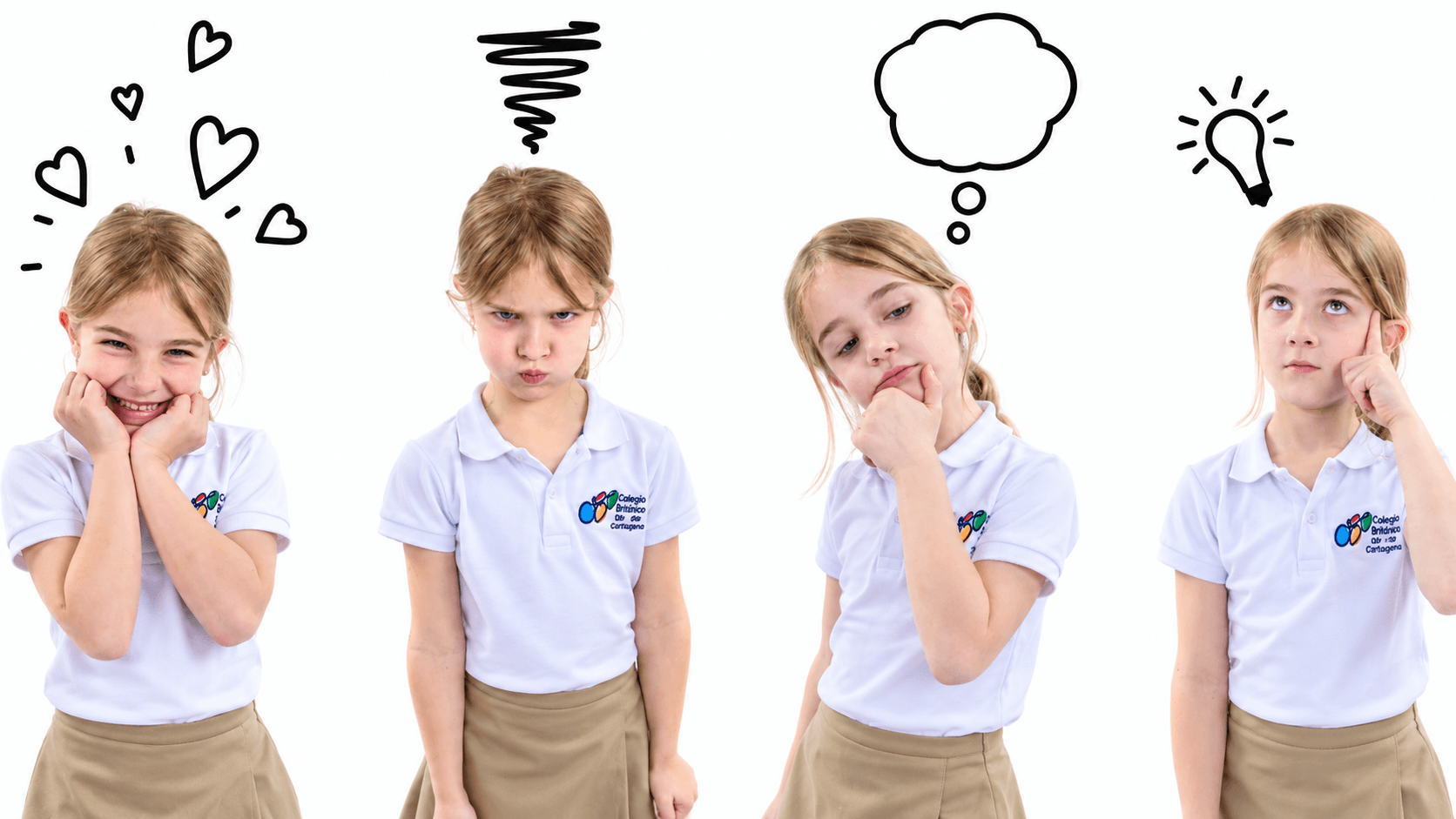
When a child feels frustrated because something doesn’t go as expected, their reaction may be influenced by emotions they are still learning to identify. That’s why, before asking them to resolve a conflict, it’s important to help them understand what they’re feeling and why. Recognizing emotions is one of the first steps toward responding to a difficult situation without acting solely on impulse.
This skill is also linked to the development of empathy. During a disagreement, each person interprets what happened based on their own experiences, emotions, and expectations. Learning to consider other perspectives helps children understand that the same situation can evoke different feelings and that listening to someone else does not necessarily mean agreeing with them.
In addition, conflict resolution helps develop skills such as communication, self-regulation, decision-making, and responsibility. A student who learns to express their needs, listen to others’ opinions, and reflect on the consequences of their actions has the tools to navigate situations that require collaboration and respect.
These skills also have an impact on the school experience. Students are constantly engaged in group work, sports activities, projects, and social settings where they need to negotiate, share responsibilities, and reach agreements. Therefore, learning to manage differences is not an isolated skill, but rather one that goes hand in hand with their academic, social, and personal development.
It is important to remember that resolving conflicts does not mean that children should handle every situation on their own. Adult guidance remains essential, especially when there is a power imbalance, behavior that affects safety, or a situation that requires intervention. The goal is for students to gradually learn to recognize when they can find a solution through dialogue and when they need to ask for help.
What is RULER, and how does it help students manage conflicts?
RULER is a social and emotional learning approach developed by the Yale Center for Emotional Intelligence. Its purpose is to strengthen five fundamental skills of emotional intelligence: recognizing, understanding, naming, expressing, and regulating emotions. These skills enable children, adolescents, and adults to develop greater awareness of what they are feeling and to learn how to use that information to interact with others and make decisions.
The first step is to recognize your own emotions and those of others. During a disagreement, one student may feel frustration, sadness, embarrassment, or anger, while the other person may be feeling something completely different. Identifying these emotions helps us understand that behind every reaction there is an emotional experience that deserves to be acknowledged, even if not all behaviors are acceptable.
Understanding emotions involves asking what caused them and how they might influence behavior. For example, a child might feel left out because his classmates started an activity without him, while the others may not have realized how he would interpret that situation. Exploring different perspectives helps prevent hasty conclusions and opens the door to finding solutions that take everyone’s needs into account.
Naming emotions is also important. Saying “I feel bad” is not the same as identifying that you’re feeling disappointment, frustration, or worry. Having a broader emotional vocabulary allows you to communicate more precisely what’s going on and makes it easier for adults and peers to understand how to offer support.
Based on this understanding, students can learn to express their emotions respectfully and regulate their responses. Feeling angry is not wrong, but learning to manage it can help prevent behaviors that hurt others. Taking a break, seeking support, or talking things through when you’re in a better state of mind are strategies that can promote more mindful responses.
To develop these skills, RULER offers tools such as the Mood Meter, which helps identify and name emotions, and the Meta-Moment, which encourages us to create a pause between what we feel and how we respond. It also includes the Charter, designed to help build agreements about a community’s emotional climate, and the Blueprint, which focuses specifically on empathy and conflict resolution.
The Blueprint encourages us to reflect on what happened, acknowledge how the people involved felt, understand their different perspectives, and consider what could be done to repair a relationship or better handle a similar situation in the future. In this way, conflict is no longer seen solely as a problem that must be resolved but becomes an opportunity to learn about ourselves and others.
How can schools and families teach students to resolve conflicts constructively?
Emotional education does not take place solely during a specific activity. It develops through the conversations, relationships, and experiences that students have every day. Therefore, teaching students how to resolve conflicts requires that adults also model respectful ways of expressing their emotions, listening to different points of view, and responding to difficult situations.
In a school setting, a disagreement among classmates can become an opportunity to guide reflection. Instead of focusing solely on determining who was at fault, it is also helpful to explore what happened, how each person felt, what needs were involved, and what alternatives might help resolve the situation. These questions allow us to address responsibility without neglecting empathy.
At the British School of Cartagena, the holistic educational approach recognizes that academic learning and social-emotional development are interconnected. RULER provides a framework and tools for addressing emotions as part of the educational experience, fostering reflection, communication, and the building of relationships based on respect. Its value lies not in eliminating disagreements, but in teaching skills to address them in an increasingly mindful way.
Families also play a vital role. When a child comes home and says he or she had an argument with a classmate, it’s understandable to want to resolve the situation immediately. However, before offering a solution, it can be helpful to listen to the child and ask what happened, how he or she felt, and how he or she thinks the other person might have felt. This type of conversation allows you to validate the child’s experience without automatically assuming a particular interpretation of the events.
Another opportunity arises when adults themselves face disagreements. Showing that it’s possible to express frustration without being disrespectful, to acknowledge a mistake, or to apologize teaches children that managing emotions is a lifelong learning process. Children learn not only from what is explained to them, but also from the responses they observe in the people around them.
It’s also important to teach that resolving a conflict doesn’t always mean that both people get exactly what they want. Sometimes, the solution involves setting boundaries, accepting a difference, taking responsibility, or making amends for an action that hurt someone. The key is to understand that disagreements can be addressed without resorting to aggression and that asking for help is also a valid course of action.
As students develop these skills, they gain greater resources to handle situations they will encounter both inside and outside of school. Learning to listen, recognize emotions, engage in dialogue, and make responsible decisions is part of a preparation that extends beyond the classroom and supports the development of personal, academic, and professional relationships.
At the British School of Cartagena, we believe that education also means preparing our students to understand themselves, build relationships with others, and face life’s challenges. Learning to resolve conflicts through emotional intelligence is part of that journey, because differences will always exist, but the way we choose to respond can transform our relationships.